
Free tool · no sign-up
Uptime calculator: what 99.9% really allows
99.9% uptime allows 43 min 50 s of downtime a month, or 8 h 45 min 58 s a year. Type any uptime target to see what it allows per day, week, month, quarter and year, or enter an outage to see how much uptime it leaves.
- 43 min 50 sa month at 99.9%
- 4 min 23 sa month at 99.99%
- Nothingyou type leaves your browser

How much downtime does an uptime target allow?
At 99.9% uptime your site can be down 43 min 50 s a month.
- Per day
- 1 min 26 s
- Per week
- 10 min 5 s
- Per month
- 43 min 50 s
- Per quarter
- 2 h 11 min 29 s
- Per year
- 8 h 45 min 58 s
How much uptime is left after an outage?
99.8973% uptime for the month
- 99%: met
- 99.5%: met
- 99.9%: missed
- 99.95%: missed
- 99.99%: missed
- 99.999%: missed
A month is 30.44 days and a year 365.25 days, the averages with leap years included. The math runs in your browser; nothing you type is sent anywhere.
Three things to know about uptime
99.9% is 43 min 50 s a month
That's the “three nines” most hosting and SaaS SLAs promise. Five nines is 26 s.Your uptime multiplies
Every service you depend on takes its share. Your app can't promise more than all of them together.Check often, or miss it
An outage shorter than your check interval is caught only some of the time. Every minute catches a 2-minute outage; every 5 minutes catches it about 40% of the time.
Common SLA values
The allowed downtime for the uptime targets you'll see in hosting and SaaS agreements. Most SLAs are measured per month.
| Feature | Day | Week | Month | Quarter | Year |
|---|---|---|---|---|---|
| Below three nines | |||||
| 90% | 2 h 24 min | 16 h 48 min | 3 d 1 h | 9 d 3 h | 36 d 12 h |
| 95% | 1 h 12 min | 8 h 24 min | 1 d 12 h | 4 d 13 h | 18 d 6 h |
| 99%Two nines | 14 min 24 s | 1 h 40 min 48 s | 7 h 18 min 20 s | 21 h 54 min 54 s | 3 d 15 h |
| 99.5% | 7 min 12 s | 50 min 24 s | 3 h 39 min 10 s | 10 h 57 min 27 s | 1 d 19 h |
| Three nines: the usual SLA | |||||
| 99.9%Three nines | 1 min 26 s | 10 min 5 s | 43 min 50 s | 2 h 11 min 29 s | 8 h 45 min 58 s |
| 99.95% | 43 s | 5 min 2 s | 21 min 55 s | 1 h 5 min 45 s | 4 h 22 min 59 s |
| Four and five nines | |||||
| 99.99%Four nines | 8.6 s | 1 min | 4 min 23 s | 13 min 9 s | 52 min 36 s |
| 99.999%Five nines | 864 ms | 6 s | 26 s | 1 min 19 s | 5 min 16 s |
What an SLA actually promises
An SLA (service level agreement) is a promise with a price on it. "99.9% uptime" usually means: if a month's uptime falls below that, you can ask for a credit, often a slice of that month's bill.
It doesn't mean the service will never go down, and the credit is rarely worth what the outage cost you. Three things to read in any SLA before you trust the number:
- The period. Most SLAs are measured per month. A bad hour can blow a month's 99.9% budget while still leaving the year above it.
- What counts as down. Announced maintenance, partial outages and problems on your side are usually left out. Some only count an outage when you report it.
- How you claim. Credits often have to be requested within a set time, with your own evidence. Your own monitoring is that evidence.
Your uptime is the product of everything you depend on
If your host promises 99.99% and your database 99.95%, your app can't promise more than both together. Add an auth provider and a payment API and the number drops again.
- Host99.99%
- Database99.95%
- Your app, at best99.94%
26 min 18 s
of downtime a month, from just two dependencies
0.9999 × 0.9995 is about 99.94%. That's why a realistic target for a solo-run app is usually 99.9%, not four nines.
How often you check decides what you can see
Uptime is only as precise as the monitor measuring it. A check is a snapshot: if your site is down for two minutes between two checks five minutes apart, nobody sees it.
Roughly, an outage shorter than the check interval is caught only some of the time. A 2-minute outage has about a 40% chance of being seen by a check every 5 minutes, and is always seen by a check every minute.
99.9885%
after one failed check in a month, checked every 5 minutes
Checked every 5 minutes, a month has about 8,767 checks, so one failure already takes you below 99.99%. Checked every minute, it's about 43,834 checks, and one failure leaves 99.9977%.
BugOtter checks each app every minute on Builder and Pro and every 5 minutes on Starter. On Starter, short blips can slip between checks; if you promise customers 99.95% or better, you want checks every minute. See pricing for the rest of each plan.
Why check from more than one place
A check from one place can fail for reasons that have nothing to do with your app: a network problem between that data center and your host, say.
BugOtter checks from 3 regions (US East, Europe, US West) at the same time. It only calls your app down when at least two of them fail and a retry 3 seconds later fails too. One bad route doesn't wake you up at night.
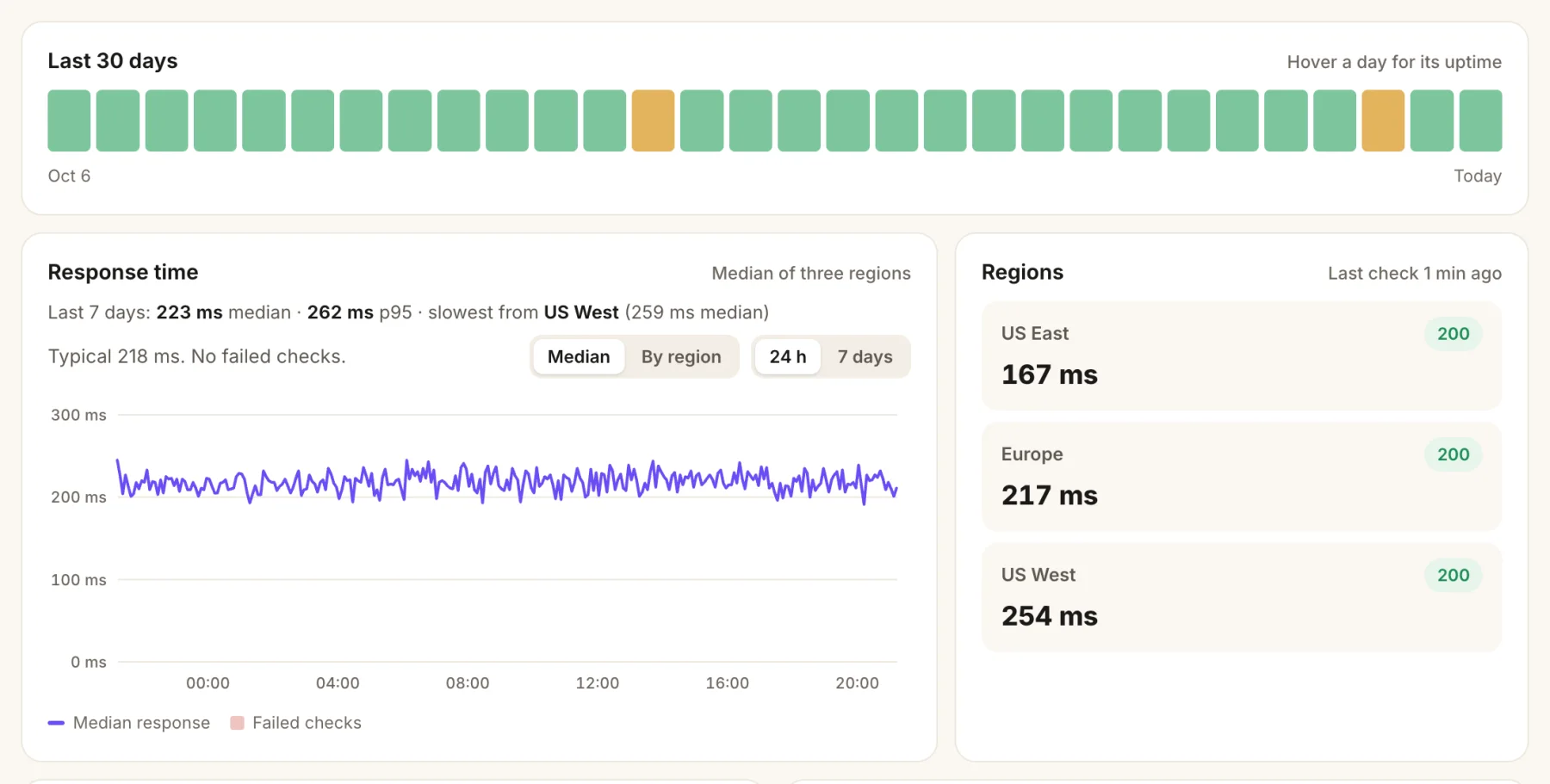
- One bar a day. Amber days had a short blip; hover for the exact uptime.
- Response time as the median of the three regions.
- Each region's last check, so you can see when only one place has trouble.
The trade-off, honestly: an outage that only one region can see isn't counted as down. For most apps that's the right call, because one region failing alone is far more often the network than your app.
Questions
How much downtime is 99.9% uptime?
99.9% uptime allows 1 min 26 s of downtime a day, 43 min 50 s a month and 8 h 45 min 58 s a year. That's the "three nines" most hosting and SaaS SLAs promise.
What does five nines mean?
Five nines is 99.999% uptime: 26 s of downtime a month, or 5 min 16 s a year. It's a target for phone networks and payment systems, and it takes redundancy across regions. A single server rarely gets there.
Why use 30.44 days for a month?
Months have 28 to 31 days, so we use the average: 365.25 days a year divided by 12 is 30.44 days. A year here is 365.25 days, so leap years are averaged in. Your provider's SLA may count calendar months instead: a 31-day month allows about 2% more downtime, a 28-day February about 8% less.
Does scheduled maintenance count as downtime?
It depends on the agreement. Most SLAs leave out maintenance that was announced in advance, so read that clause first. In BugOtter, checks that run during a maintenance window you set aren't counted in your uptime.
How does BugOtter calculate uptime?
Uptime in BugOtter is the share of checks on your app's main address that passed, leaving out checks during maintenance windows. Extra checks (an API endpoint, say) have their own results and don't change the app's uptime number.
Is 99.9% good enough for a side project?
Usually, yes. Your visitors care more about how fast you notice and fix an outage than about the second decimal. Knowing within a minute matters more than the target.
Know about downtime before your users do.
14 days of everything, no card needed. Plans from $10 a month, billed yearly.